
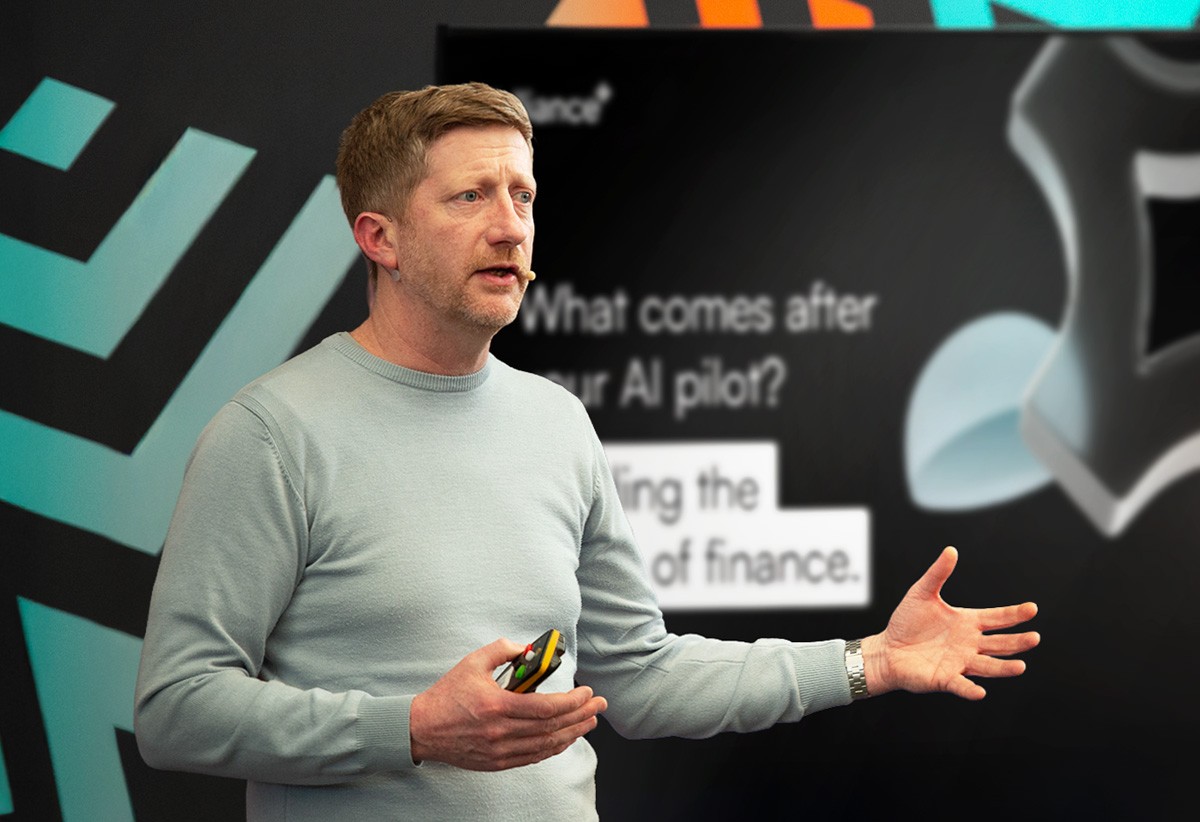


Money Live 2026 brought together leaders shaping the future of financial services. Valliance was on stage, on the stand, and right in the middle of the conversation. What became clear, is that the challenge for banks isn’t to do with AI itself - but to do with production.
Valliance’s talk opened with a question: “What comes after your AI pilot?”
40% of AI initiatives are still in pilot, and only 20% of pilot initiatives report strong ROI. In organisations that have successfully scaled AI into production, that figure jumps to 76% as discussed within our recent research report - ‘The Pilot Trap’.
This gap is almost always the path from experiment to full implementation.
The talk explored the three things we consistently see working across organisations that get this right:
People, Value and Trust
People
AI adoption stalls when people are treated as an afterthought. The technical capability exists, but what blocks deployment is on the human side: anxiety, mistrust, and a lack of fluency at every level of the organisation.
Yes, some roles will shift. Some will go altogether. But standing still is the bigger risk. The organisations winning right now are investing in AI fluency across their teams, not just inside an innovation lab. That means hands-on training, real workflows, and a culture where people feel equipped to lead what is coming, rather than feeling threatened by it.
Value
Organisations must rethink AI deployment. Rather than building AI tools, the focus should be on redesigning processes. The distinction sounds subtle, but it changes everything about how AI work is scoped, funded, and measured.
The biggest mistake we see is organisations building isolated AI models - a chatbot here, a classifier there, without changing the underlying process. Real value comes when workflows are designed around what AI makes possible. That means moving from manual steps and fragmented teams to automated decisions and intelligent support, all tied to a financial outcome that can be measured from day one.
We presented four working examples of what this could look like in practice for financial services.
Using fuzzy logic for credit risk assessments


Our FuzzyLLM demonstration applies structured fuzzy logic to produce a deterministic, traceable credit score, then uses an LLM to explain the decision in plain language. The score is consistent and the reasoning behind it is transparent, so that regulators and analysts can follow every step. Credit decisions are rarely binary; FuzzyLLM is built to reflect that reality without sacrificing auditability.
Automating regulation compliance


The PrologLLM Rules Engine takes regulation out of PDFs and turns it into executable logic, eradicating the need for compliance teams to manually interpret policy, and instead automating the application process. Every decision produces a proof tree showing exactly why it was made, so the audit trail is built in from day one.
Making performance data easier and faster to access


Our BI+LLM Unified Time Series demo turns time-series performance data into conversation. Leaders ask questions and get the drivers of margin shift, revenue movement, or emerging risk surfaced directly. Answers are delivered instantly, so there’s no more queueing for analyst time, and no need to wait for the report.
Everything underpinned by a robust enterprise ontology


The enterprise ontology underpins all of it. Banks operate across hundreds of systems with fragmented, inconsistent data models. Without a shared operational view — one that maps customers, accounts, transactions, products, and alerts precisely — everything built on top of it is fragile. The ontology is not a product, but the foundation that makes every AI application downstream smarter, faster, and more trustworthy.
Trust always
Trust is built through explainability, transparency in data, and governance models that give everyone a shared view of risk. Concepts like enterprise ontologies and explainable AI frameworks make deployment possible in a regulated environment, and should therefore be considered as the foundation that everything else depends on.
What we heard on the floor
As mentioned above, trust was a dominant theme across Money Live, not just in AI-specific sessions, but woven through almost every conversation on the stand. If people do not trust it, it will never ship. That applies to end users, regulators, and the leaders signing off on deployment.
One standout contribution came from a senior leader at one of the UK’s largest financial institutions. They shared how AI-led innovation depends on three things, that closely matched what we’d asserted on stage: data as the foundation, innovation distributed across the whole organisation rather than confined to a lab, and collaboration as the multiplier. The organisations generating the best results are combining internal expertise, integration partners, and technology partners to move ideas from concept to market at pace.
A number of other key highlights and observations from the talks include:
Across a number of sessions, financial domain-specific LLMs emerged as a growing area of interest. The aim is to give customers more consistent and trustworthy guidance than a general web search can provide. People are already using AI to make financial decisions, and the quality and consistency of what they receive varies enormously.
Regulation came up repeatedly, and not in the way it usually does. A year ago, governance felt like a blocker, but now, it’s instead treated as a design constraint — something that should be built around from the start, rather than something that’s retrofitted when deployment stalls. This shift in attitude shows progress.
We also heard consistent frustration with the pace of internal alignment. Technical teams and vendors are ready, but deployment is slowed due to the number of stakeholders who need to reach the same level of confidence before a decision can move ahead. Organisations that have solved this tend to have one thing in common: a clear owner for AI outcomes, with the authority and access to make decisions across functions.
The question of build versus buy is becoming less useful. What separates organisations making progress from those still planning is integration depth: how well AI connects to the systems, processes, and people that make a business run. The most interesting conversations were not about the models, but about the pipes underpinning them.
While banking and financial services have used AI longer than most sectors, unlocking its real value at scale, in production, with governance that holds, remains the central challenge of this moment.
What’s next for AI in finance
The conversations at Money Live pointed in one direction. Experiments have run, pilots have proved concepts and the business case for AI in financial services is no longer a question anyone is seriously asking. The questions now are harder and more interesting: how do you govern AI models at scale without creating overhead that kills deployment speed? How do you build explainability into systems that are already live? How do you bring your people with you when the pace of change feels relentless?
And the one that kept surfacing, in different forms, across different conversations, is: how do you know when you are genuinely ready to move AI from the lab into the core of your business, and who should make that decision?
There is no universal answer, but there is a pattern in the organisations getting it right. They start with people, build for value, and never let trust become an afterthought.
If you missed us at Money Live, or if you were there and the conversation sparked something worth continuing, let’s keep it going.
About Valliance
We’re a new breed of consultancy helping financial services and enterprise organisations move from AI experimentation to AI in production. Get in touch if you’d like to hear more or see the demos in action for yourself.