

Valliance logo in black

Dec 9, 2025

·

10 Mins

Dec 9, 2025

·

10 Mins

Dec 9, 2025

·

10 Mins

Dec 9, 2025

·

10 Mins

Topics

Future Interaction Models

Future Interaction Models

Future Interaction Models

Human-centered AI

Human-centered AI

Human-centered AI

Tools & Automation

Tools & Automation

Tools & Automation

AI Transparency

AI Transparency

AI Transparency

AI is a powerful accelerant for how work gets done, but this comes with a new set of challenges. Surprisingly, the technology itself is not the biggest issue. The real challenge for enterprises is far more human: aligning what the business needs, what AI can realistically deliver today, and how people will actually interact with these systems inside their daily workflows.

When these three things are misaligned, you get failed pilots, disconnected tooling, and "AI workslop" outputs nobody trusts. When they are aligned, AI becomes a value engine, accelerating productivity, improving decision quality, and strengthening organisational trust with every cycle. The AI amplification of organisational intelligence creates a competitive advantage that cannot be replicated.

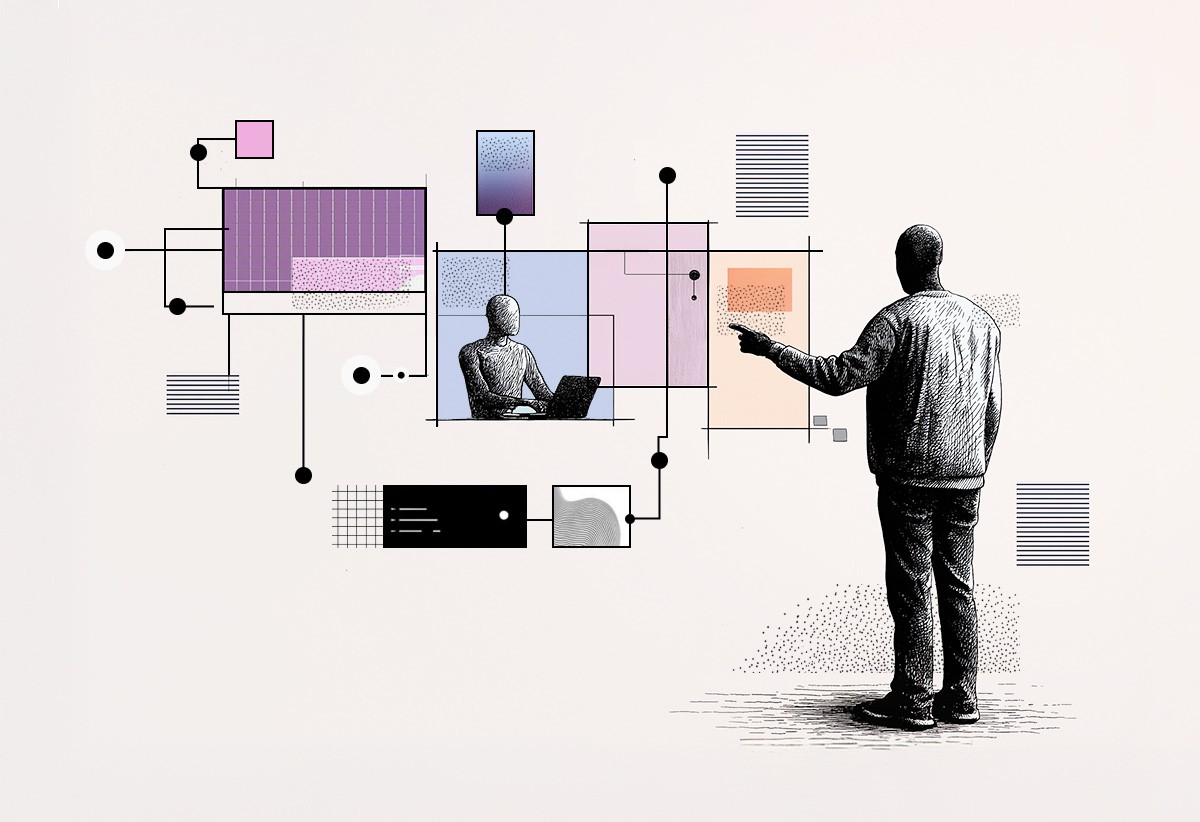
At Valliance we have a human-first approach to AI transformation, and understanding how people will interact with these systems is critical. We are building on decades of digital experience and human-centred design principles to pioneer the interaction models the future enterprise demands. From diverse agents with distinct personalities working amongst your teams helping to co-pilot tasks, to control tower dashboards that give you visibility over fully autonomous workflow operations.

We are shifting from traditional human-computer interaction towards human-enterprise interaction, a model where people work alongside networks of autonomous and assistive AI systems, and where the two-way flow of knowledge means the organisation learns and improves from its own behaviour in real time.

Changing how we think about UX in the AI context

For years, UX patterns meant screens, flows, and step-by-step tasks. Enterprise systems were fixed, deterministic, and limited by predefined workflows.

AI breaks this model. Workflows become adaptive, interfaces become anticipatory, and interaction shifts from "going to systems" to systems coming to you.

We group human-enterprise patterns into three overlapping horizons - Assistive, Autonomous, and Ambient - that form a framework for how interaction patterns evolve within the future enterprise.

Assistive AI patterns

Assistive AI acts as a copilot or intelligent helper, always requiring user direction or confirmation. These patterns help build clarity by keeping humans firmly in control whilst AI enhances their capabilities.

These can include:

  • Inline copilots and suggestions that appear where people already work (documents, tickets, emails, product tools) reducing context switching.

  • Intelligent search and explainers that surface the right knowledge instantly, rather than sending teams on a treasure hunt through SharePoint, old PowerPoint decks, or Slack.

  • Recommendation engines that propose next steps but leave decisions with people.

  • Smart error detection that flags risks before they grow.

  • Contextual tone and sentiment feedback that helps improve communication without feeling intrusive.

Value created: Assistive AI delivers faster throughput by accelerating how quickly work moves through the system. It reduces time wasted searching for information, ensuring teams can find what they need instantly. This leads to higher-quality decision-making, as people have better context and insights at their fingertips. Additionally, assistive AI enables earlier risk detection, flagging potential issues before they escalate into costly problems.

Why this matters: Assistive AI increases productivity without requiring behavioural change, a critical foundation for adoption.

How it’s already evolving; When we think about AI interaction, most of us picture chat interfaces: dedicated spaces you navigate to, like ChatGPT. These conversational UIs are powerful for quick queries, but they struggle with sustained collaborative work: drafting documents, iterating designs, building complex outputs. Trying to write, edit, amend, and rewrite a long-form article in ChatGPT became a unique form of torture as the AI hallucinated, re-worded, or removed whole sections without warning. Newer inline tools (Copilot, Figma AI, Notion AI) solve this differently. They meet you where you're already working, with no tab-switching and no context loss. As these tools mature, the AI layer will fade into the background. We won't think "I'm using AI now." We'll just work. That said, many copilot implementations still feel rough around the edges. Results vary. We're watching closely to see which tools evolve meaningfully versus which remain clunky bolt-ons. However, the real opportunity lies with the platforms designed AI-first from the ground up, not legacy tools with LLM features grafted on.

Autonomous patterns

Autonomous patterns shift AI from "helper" to "doer." AI agents can plan, act, and execute decisions within defined boundaries with minimal user intervention. It’s important to note though, that teams will interact with agents in different ways. We've grouped these into four roles: Agent Orchestrators who will be responsible for designing multi-agent workflows, Agent Supervisors who provide oversight and handle exceptions, Agent Collaborators who will work side-by-side with AI agents as peers, and Passive Recipients who benefit from AI-optimised environments without direct interaction.

Autonomous patterns move from reactive assistance to proactive execution, with humans providing strategic oversight rather than constant direction.

These can include:

  • Workflow agents that complete multi-step processes end-to-end.

  • Customer self-service bots that resolve standard queries without human involvement.

  • Agent-human collaboration, where AI requests clarification, approvals, or escalation.

  • Agent networks, where multiple specialised agents work together and hand off tasks.

  • Adaptive dashboards that reshape themselves based on role, behaviour, and business context.

Value created: Autonomous AI dramatically reduces operational costs by completing entire workflows without human intervention. It eliminates process friction, ensuring work moves smoothly between systems and teams without manual handoffs. Service levels improve as tasks execute faster and more consistently, whilst fewer items get lost or delayed between teams, creating more reliable, predictable operations.

Why this matters: Autonomy is where enterprises unlock real ROI, but it only delivers when trust, governance, and oversight are built in from the start, making robust commercial models, risk controls, and clear operating structures essential.

Our recent experience: In our work with enterprise teams, we've noticed something interesting; most people intuitively grasp the idea AI chat and chatbots, but "agents" still feel abstract. During a recent ideation triage project, we realised there's a real education gap here. Teams needed help understanding what an AI agent actually is and how it changes their day-to-day work. We're not alone in seeing this. To bridge the gap, startups and platforms are giving agents more human qualities: names, avatars, distinct voices, even accents. These anthropomorphic touches aren't just cosmetic, they make agents feel less alien as they become genuine workflow participants. Imagine you're chatting with your team in Slack about a tricky issue, and you need to check a compliance policy. Instead of disappearing into a 200-document SharePoint maze, you simply invite your compliance agent into the thread. They have a name, a consistent writing style, and an assuring authoritative tone. You get your answer immediately, in context, without breaking flow. The knowledge flows seamlessly into your work, and the questions you ask, and the edge cases you surface, flow back to the compliance team to refine policy over time. It's a two-way stream, and starts to show the acceleration that AI can do for enterprise knowledge management.

Ambient patterns

Ambient AI represents the maturity point: AI fully embedded into workflows, quietly improving outcomes without requiring a dedicated interface. It is in the background, optimising schedules, routing requests, surfacing insights at precisely the right moment. Users experience better outcomes without needing to understand the mechanism.

The technology becomes knowledge infrastructure rather than interface, and human attention stays focussed on high-value judgement and creativity rather than system interaction. It becomes the pinnacle of AI systems as there is complete inherent trust in an always-on AI system.

These can include:

  • Passive knowledge capture from meetings, conversations, and workflow tools, generating summaries, actions, and shared understanding.

  • Predictive nudges sent only when needed, missed deadlines, emerging risks, unusual patterns.

  • Intelligent case routing that matches work to the best person or team based on expertise and load.

  • Engagement sensing that surfaces wellbeing or morale shifts before they become issues.

  • Automated data hygiene that cleans and reconciles information continuously in the background.

Value created: Ambient AI drives higher organisational alignment by ensuring the right information reaches the right people at the right time, without manual effort. It creates more resilient operations through continuous monitoring and adaptive responses to changing conditions. Data quality improves automatically as systems clean and reconcile information in the background, powering better decisions across the enterprise. Additionally, ambient AI delivers cultural benefits by increasing transparency, reducing friction between teams, and freeing people to focus on meaningful work rather than administrative overhead.

Why this matters: This is where enterprises shift from reacting to events to anticipating them, building competitive advantage through always-on intelligence that compounds over time.

Additional thoughts: When discussing the future trajectory of AI systems, it's tempting to leap straight to grand visions: fully autonomous enterprises, AI systems that anticipate every need. But that kind of thinking can quickly drift into hand-waving science fiction. The reality is more grounded and, pragmatically, more useful. Right now, the value lies in identifying small, repeatable tasks that can be automated reliably, or deploying foundational AI copilots that genuinely enhance how people work today. Focus more on something like automating invoice reconciliation, rather than reimagining your entire finance function overnight. Ambient AI is absolutely the right North Star. It represents where we want to go. But we need to be honest about timelines. Getting to truly ambient, always-on, trusted AI systems isn't a roadmap measured in quarters. For most enterprises, we're talking years, possibly decades, depending on industry maturity, data infrastructure, and organisational readiness. The risk of overpromising here is real: teams get disillusioned, budgets get pulled, and valuable incremental progress gets abandoned. Better to build momentum through small wins, prove value consistently, and let ambient capabilities emerge naturally as trust and capability compound over time.

These patterns solve problems that really matter

The patterns above align to the increasing maturity of the underpinning technology, and what it can deliver today, and hopefully in the future. But the final piece of the puzzle is understanding what enterprise problems we are fundamentally trying to solve? There are core problems that all enterprises have always struggled with that AI can finally start to tackle. Deploying AI without strategy into a business will only amplify issues such as knowledge silos, process chaos, or decision paralysis. But done correctly, you can start to not only tackle them, but potentially resolve them once and for all.

Knowledge siloes become connected intelligence

The problem: Your best knowledge lives in people's heads, scattered across Slack threads, or buried in folders and documents no one can find.

How it works: Your team keeps working naturally. AI learns from behaviour, builds connections from your entire knowledge base, and delivers relevant context on demand. When marketing needs competitive intel, they get analysis, past strategies, and expert contacts instantly. No asking around.

Process chaos becomes smart workflows

The problem: Work gets stuck between teams. Tasks fall through cracks. Everyone is rebuilding the wheel.

How it works: Routine work flows automatically. When something unusual appears, AI flags it for human review. You create rules once; AI applies them everywhere. Invoice processing runs itself until it hits an edge case. Then you decide, and the system gets smarter.

Decision paralysis becomes real-time intelligence

The problem: Too much data, not enough insight. By the time you have analysed everything, the moment has passed.

How it works: AI spots signal in the noise. You provide context and judgement. Together you are faster and smarter. AI surfaces unusual patterns, you validate and refine, the system learns from your decisions.

Fragmented customer experience becomes seamless orchestration

The problem: Customers repeat themselves across channels. Context gets lost. Experience feels disconnected.

How it works: AI resolves standard queries instantly. Complex issues go to humans with complete history. Your team focuses on relationship-building, not information gathering. The system learns from every interaction.

Data quality nightmares become self-healing systems

The problem: Bad data compounds. Manual cleaning does not scale. Compliance is reactive.

How it works: Set policies once. AI enforces them everywhere. Standard issues get fixed automatically. Complex cases come to you with context. Your rules become system-wide intelligence that improves over time.

What will we see next?

Progression won't happen overnight. For most enterprises, it builds in stages: from existing human-centric systems, to collaborative human-AI systems (integrating human and AI capabilities for unified decision-making), to multi-agent systems (where agents maintain autonomy through structured cooperation), to eventually ambient always-on intelligence.

The transformation from assistive tools to ambient intelligence won't happen through grand strategy alone. It will emerge from teams identifying real problems, testing new patterns, and building trust one workflow at a time. This bottom-up, people-first approach ensures businesses adopt AI at their own pace, the work remains meaningful, and AI fluency grows organically across the organisation.

The enterprises that will lead aren't waiting for perfect clarity. They're experimenting with these patterns now, learning what works in their context, building the muscle memory their organisations will need. And in doing so, they're creating the alignment between business needs, AI capabilities, and human workflows that turns AI from isolated tooling into a sustainable competitive advantage.


Topics

Future Interaction Models

Future Interaction Models

Future Interaction Models

Human-centered AI

Human-centered AI

Human-centered AI

Tools & Automation

Tools & Automation

Tools & Automation

AI Transparency

AI is a powerful accelerant for how work gets done, but this comes with a new set of challenges. Surprisingly, the technology itself is not the biggest issue. The real challenge for enterprises is far more human: aligning what the business needs, what AI can realistically deliver today, and how people will actually interact with these systems inside their daily workflows.

When these three things are misaligned, you get failed pilots, disconnected tooling, and "AI workslop" outputs nobody trusts. When they are aligned, AI becomes a value engine, accelerating productivity, improving decision quality, and strengthening organisational trust with every cycle. The AI amplification of organisational intelligence creates a competitive advantage that cannot be replicated.

At Valliance we have a human-first approach to AI transformation, and understanding how people will interact with these systems is critical. We are building on decades of digital experience and human-centred design principles to pioneer the interaction models the future enterprise demands. From diverse agents with distinct personalities working amongst your teams helping to co-pilot tasks, to control tower dashboards that give you visibility over fully autonomous workflow operations.

We are shifting from traditional human-computer interaction towards human-enterprise interaction, a model where people work alongside networks of autonomous and assistive AI systems, and where the two-way flow of knowledge means the organisation learns and improves from its own behaviour in real time.

Changing how we think about UX in the AI context

For years, UX patterns meant screens, flows, and step-by-step tasks. Enterprise systems were fixed, deterministic, and limited by predefined workflows.

AI breaks this model. Workflows become adaptive, interfaces become anticipatory, and interaction shifts from "going to systems" to systems coming to you.

We group human-enterprise patterns into three overlapping horizons - Assistive, Autonomous, and Ambient - that form a framework for how interaction patterns evolve within the future enterprise.

Assistive AI patterns

Assistive AI acts as a copilot or intelligent helper, always requiring user direction or confirmation. These patterns help build clarity by keeping humans firmly in control whilst AI enhances their capabilities.

These can include:

  • Inline copilots and suggestions that appear where people already work (documents, tickets, emails, product tools) reducing context switching.

  • Intelligent search and explainers that surface the right knowledge instantly, rather than sending teams on a treasure hunt through SharePoint, old PowerPoint decks, or Slack.

  • Recommendation engines that propose next steps but leave decisions with people.

  • Smart error detection that flags risks before they grow.

  • Contextual tone and sentiment feedback that helps improve communication without feeling intrusive.

Value created: Assistive AI delivers faster throughput by accelerating how quickly work moves through the system. It reduces time wasted searching for information, ensuring teams can find what they need instantly. This leads to higher-quality decision-making, as people have better context and insights at their fingertips. Additionally, assistive AI enables earlier risk detection, flagging potential issues before they escalate into costly problems.

Why this matters: Assistive AI increases productivity without requiring behavioural change, a critical foundation for adoption.

How it’s already evolving; When we think about AI interaction, most of us picture chat interfaces: dedicated spaces you navigate to, like ChatGPT. These conversational UIs are powerful for quick queries, but they struggle with sustained collaborative work: drafting documents, iterating designs, building complex outputs. Trying to write, edit, amend, and rewrite a long-form article in ChatGPT became a unique form of torture as the AI hallucinated, re-worded, or removed whole sections without warning. Newer inline tools (Copilot, Figma AI, Notion AI) solve this differently. They meet you where you're already working, with no tab-switching and no context loss. As these tools mature, the AI layer will fade into the background. We won't think "I'm using AI now." We'll just work. That said, many copilot implementations still feel rough around the edges. Results vary. We're watching closely to see which tools evolve meaningfully versus which remain clunky bolt-ons. However, the real opportunity lies with the platforms designed AI-first from the ground up, not legacy tools with LLM features grafted on.

Autonomous patterns

Autonomous patterns shift AI from "helper" to "doer." AI agents can plan, act, and execute decisions within defined boundaries with minimal user intervention. It’s important to note though, that teams will interact with agents in different ways. We've grouped these into four roles: Agent Orchestrators who will be responsible for designing multi-agent workflows, Agent Supervisors who provide oversight and handle exceptions, Agent Collaborators who will work side-by-side with AI agents as peers, and Passive Recipients who benefit from AI-optimised environments without direct interaction.

Autonomous patterns move from reactive assistance to proactive execution, with humans providing strategic oversight rather than constant direction.

These can include:

  • Workflow agents that complete multi-step processes end-to-end.

  • Customer self-service bots that resolve standard queries without human involvement.

  • Agent-human collaboration, where AI requests clarification, approvals, or escalation.

  • Agent networks, where multiple specialised agents work together and hand off tasks.

  • Adaptive dashboards that reshape themselves based on role, behaviour, and business context.

Value created: Autonomous AI dramatically reduces operational costs by completing entire workflows without human intervention. It eliminates process friction, ensuring work moves smoothly between systems and teams without manual handoffs. Service levels improve as tasks execute faster and more consistently, whilst fewer items get lost or delayed between teams, creating more reliable, predictable operations.

Why this matters: Autonomy is where enterprises unlock real ROI, but it only delivers when trust, governance, and oversight are built in from the start, making robust commercial models, risk controls, and clear operating structures essential.

Our recent experience: In our work with enterprise teams, we've noticed something interesting; most people intuitively grasp the idea AI chat and chatbots, but "agents" still feel abstract. During a recent ideation triage project, we realised there's a real education gap here. Teams needed help understanding what an AI agent actually is and how it changes their day-to-day work. We're not alone in seeing this. To bridge the gap, startups and platforms are giving agents more human qualities: names, avatars, distinct voices, even accents. These anthropomorphic touches aren't just cosmetic, they make agents feel less alien as they become genuine workflow participants. Imagine you're chatting with your team in Slack about a tricky issue, and you need to check a compliance policy. Instead of disappearing into a 200-document SharePoint maze, you simply invite your compliance agent into the thread. They have a name, a consistent writing style, and an assuring authoritative tone. You get your answer immediately, in context, without breaking flow. The knowledge flows seamlessly into your work, and the questions you ask, and the edge cases you surface, flow back to the compliance team to refine policy over time. It's a two-way stream, and starts to show the acceleration that AI can do for enterprise knowledge management.

Ambient patterns

Ambient AI represents the maturity point: AI fully embedded into workflows, quietly improving outcomes without requiring a dedicated interface. It is in the background, optimising schedules, routing requests, surfacing insights at precisely the right moment. Users experience better outcomes without needing to understand the mechanism.

The technology becomes knowledge infrastructure rather than interface, and human attention stays focussed on high-value judgement and creativity rather than system interaction. It becomes the pinnacle of AI systems as there is complete inherent trust in an always-on AI system.

These can include:

  • Passive knowledge capture from meetings, conversations, and workflow tools, generating summaries, actions, and shared understanding.

  • Predictive nudges sent only when needed, missed deadlines, emerging risks, unusual patterns.

  • Intelligent case routing that matches work to the best person or team based on expertise and load.

  • Engagement sensing that surfaces wellbeing or morale shifts before they become issues.

  • Automated data hygiene that cleans and reconciles information continuously in the background.

Value created: Ambient AI drives higher organisational alignment by ensuring the right information reaches the right people at the right time, without manual effort. It creates more resilient operations through continuous monitoring and adaptive responses to changing conditions. Data quality improves automatically as systems clean and reconcile information in the background, powering better decisions across the enterprise. Additionally, ambient AI delivers cultural benefits by increasing transparency, reducing friction between teams, and freeing people to focus on meaningful work rather than administrative overhead.

Why this matters: This is where enterprises shift from reacting to events to anticipating them, building competitive advantage through always-on intelligence that compounds over time.

Additional thoughts: When discussing the future trajectory of AI systems, it's tempting to leap straight to grand visions: fully autonomous enterprises, AI systems that anticipate every need. But that kind of thinking can quickly drift into hand-waving science fiction. The reality is more grounded and, pragmatically, more useful. Right now, the value lies in identifying small, repeatable tasks that can be automated reliably, or deploying foundational AI copilots that genuinely enhance how people work today. Focus more on something like automating invoice reconciliation, rather than reimagining your entire finance function overnight. Ambient AI is absolutely the right North Star. It represents where we want to go. But we need to be honest about timelines. Getting to truly ambient, always-on, trusted AI systems isn't a roadmap measured in quarters. For most enterprises, we're talking years, possibly decades, depending on industry maturity, data infrastructure, and organisational readiness. The risk of overpromising here is real: teams get disillusioned, budgets get pulled, and valuable incremental progress gets abandoned. Better to build momentum through small wins, prove value consistently, and let ambient capabilities emerge naturally as trust and capability compound over time.

These patterns solve problems that really matter

The patterns above align to the increasing maturity of the underpinning technology, and what it can deliver today, and hopefully in the future. But the final piece of the puzzle is understanding what enterprise problems we are fundamentally trying to solve? There are core problems that all enterprises have always struggled with that AI can finally start to tackle. Deploying AI without strategy into a business will only amplify issues such as knowledge silos, process chaos, or decision paralysis. But done correctly, you can start to not only tackle them, but potentially resolve them once and for all.

Knowledge siloes become connected intelligence

The problem: Your best knowledge lives in people's heads, scattered across Slack threads, or buried in folders and documents no one can find.

How it works: Your team keeps working naturally. AI learns from behaviour, builds connections from your entire knowledge base, and delivers relevant context on demand. When marketing needs competitive intel, they get analysis, past strategies, and expert contacts instantly. No asking around.

Process chaos becomes smart workflows

The problem: Work gets stuck between teams. Tasks fall through cracks. Everyone is rebuilding the wheel.

How it works: Routine work flows automatically. When something unusual appears, AI flags it for human review. You create rules once; AI applies them everywhere. Invoice processing runs itself until it hits an edge case. Then you decide, and the system gets smarter.

Decision paralysis becomes real-time intelligence

The problem: Too much data, not enough insight. By the time you have analysed everything, the moment has passed.

How it works: AI spots signal in the noise. You provide context and judgement. Together you are faster and smarter. AI surfaces unusual patterns, you validate and refine, the system learns from your decisions.

Fragmented customer experience becomes seamless orchestration

The problem: Customers repeat themselves across channels. Context gets lost. Experience feels disconnected.

How it works: AI resolves standard queries instantly. Complex issues go to humans with complete history. Your team focuses on relationship-building, not information gathering. The system learns from every interaction.

Data quality nightmares become self-healing systems

The problem: Bad data compounds. Manual cleaning does not scale. Compliance is reactive.

How it works: Set policies once. AI enforces them everywhere. Standard issues get fixed automatically. Complex cases come to you with context. Your rules become system-wide intelligence that improves over time.

What will we see next?

Progression won't happen overnight. For most enterprises, it builds in stages: from existing human-centric systems, to collaborative human-AI systems (integrating human and AI capabilities for unified decision-making), to multi-agent systems (where agents maintain autonomy through structured cooperation), to eventually ambient always-on intelligence.

The transformation from assistive tools to ambient intelligence won't happen through grand strategy alone. It will emerge from teams identifying real problems, testing new patterns, and building trust one workflow at a time. This bottom-up, people-first approach ensures businesses adopt AI at their own pace, the work remains meaningful, and AI fluency grows organically across the organisation.

The enterprises that will lead aren't waiting for perfect clarity. They're experimenting with these patterns now, learning what works in their context, building the muscle memory their organisations will need. And in doing so, they're creating the alignment between business needs, AI capabilities, and human workflows that turns AI from isolated tooling into a sustainable competitive advantage.

Topics

Future Interaction Models

Human-centered AI

Tools & Automation

Are you ready to shape the future enterprise?

Get in touch, and let's talk about what's next.

Are you ready to shape the future enterprise?

Get in touch, and let's talk about what's next.

_Related thinking
_Related thinking
_Related thinking
_Related thinking
_Related thinking
_Explore our themes
_Explore our themes
_Explore our themes
_Explore our themes

Seasons Greetings

Seasons Greetings

Seasons Greetings

Seasons Greetings

Seasons Greetings

Let’s put AI to work.

Copyright © 2025 Valliance. All rights reserved.

Let’s put AI to work.

Copyright © 2025 Valliance. All rights reserved.

Let’s put AI to work.

Copyright © 2025 Valliance. All rights reserved.

Let’s put AI to work.

Copyright © 2025 Valliance. All rights reserved.